3.3 The ossicular solution
How do you couple a low-impedance medium (air) to a high-impedance one (cochlear fluid) without losing the energy to reflection? You build a transformer. The middle ear is a mechanical transformer with two compounding tricks.
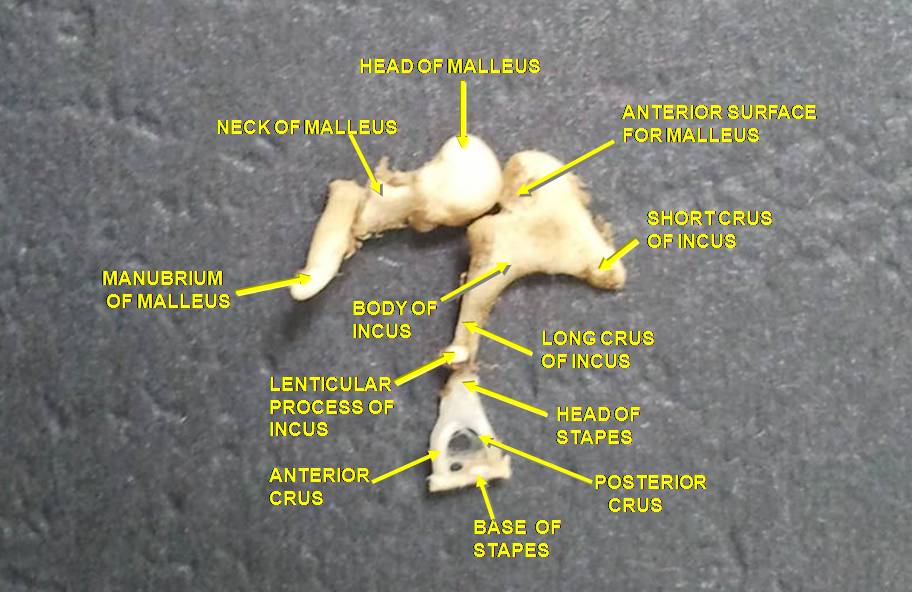
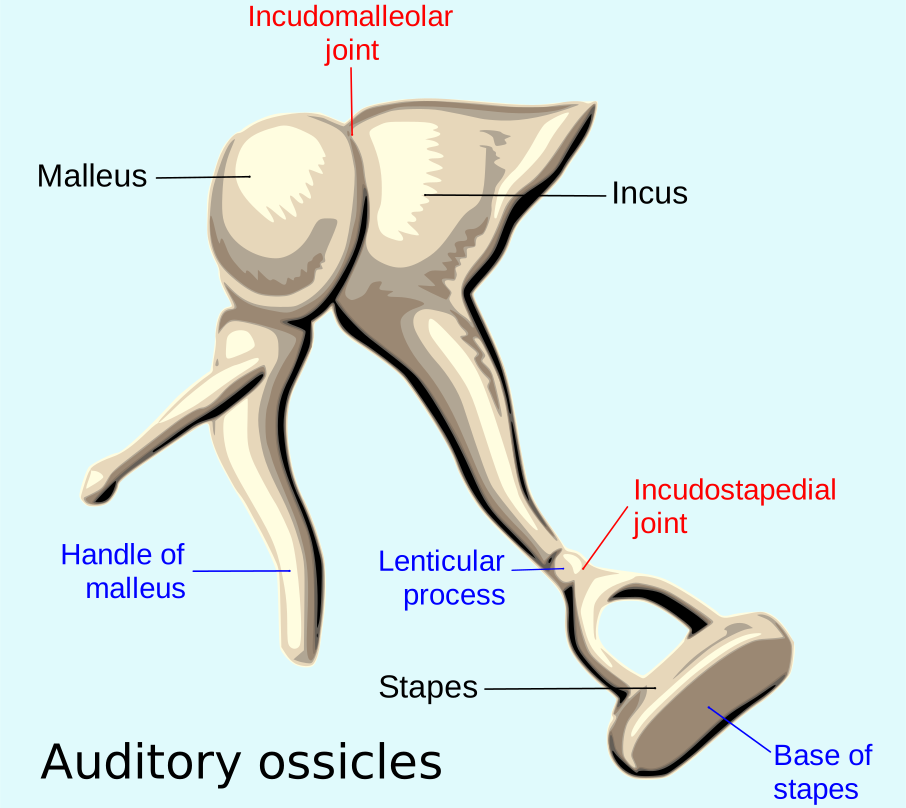
Area ratio
The eardrum (tympanic membrane) has an area of about . The stapes footplate, which contacts the oval window, has an area of about . A given pressure acts over the eardrum, producing a force . That force is transferred (via the ossicular chain) to the stapes, where it acts over a much smaller area: the pressure at the oval window is . So
A 17-fold pressure amplification from area concentration alone.
▶ Derivation: pressure amplification from area concentration Derivation
The total force exerted by a pressure acting over an area is . If the same force is transmitted to a smaller area (via a rigid mechanical chain), the new pressure is
The pressure amplification is the area ratio: .
For the middle ear, . Note: this assumes the entire tympanic membrane moves in unison, which is roughly true at low frequencies. At high frequencies the membrane moves in higher-order vibrational modes that reduce the effective area ratio. ∎
Lever ratio
The three ossicles (malleus, incus, stapes) form a lever. The malleus is attached to the eardrum and rotates about a pivot near its head; the incus pivots about the same axis. The geometry is such that the malleus arm is slightly longer than the incus arm, giving a lever ratio of about
This is small but matters.
Combining
The two effects multiply. The total pressure gain from eardrum to oval window is approximately
In decibels, .
This recovers most — though not all — of the 30 dB lost to impedance mismatch. The net transmission of the middle ear into the cochlea is roughly 60% of the incoming intensity — a remarkable feat for a mechanical assembly the size of a grain of rice.
- impedance mismatch loss
- -29.6 dB
- ossicular pressure gain
- +26.9 dB
- net SPL at oval window
- -2.7 dB