2.2 Head shadow and diffraction
The simple head-shadow model used in 2.1 is a 1907 approximation (Rayleigh). The real head is not a sphere, it has hair, the ear is recessed from the surface, and the neck contributes too. The full diffraction problem — solving the Helmholtz equation around a 3-D obstacle of the shape of a human head — is analytically intractable but computationally accessible. Realistic numerical solutions (boundary-element methods, or measurements of actual heads with sensitive microphones at the eardrum) yield head-related transfer functions (HRTFs) that are far richer than the simple sphere predicts.
For some purposes — virtual reality audio, headphone-based 3-D sound — the ILD/ITD plus a smooth-head-shadow approximation is enough. For more demanding cases — accurate vertical localization, front-back disambiguation — the listener’s individual HRTF matters. Generic HRTFs (averaged across many subjects, or measured on a manikin like the KEMAR) sound “almost right” but never perfectly so. The brain knows what its own head’s HRTF is — it has been listening through it since birth.
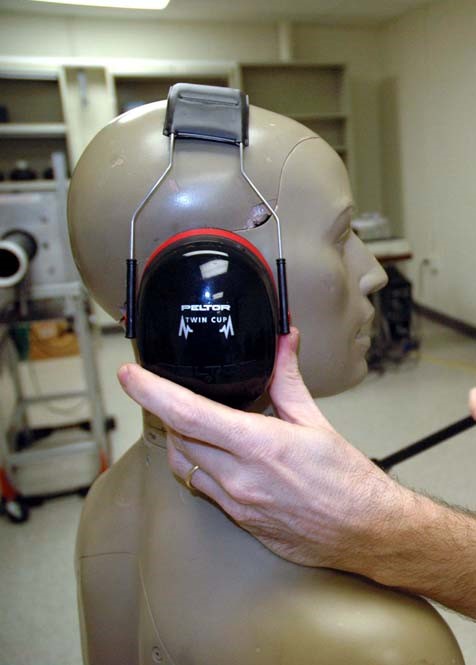
KEMAR is, in effect, a measurement of what the average head does to sound, frozen into a single physical object. Plug a calibrated microphone into each ear, place the manikin in an anechoic chamber, sweep tones from every direction, and read off the transfer functions directly. The CIPIC, ARI, and SADIE HRTF databases were all measured this way (or with similar manikins). When you put on headphones and hear convincing 3-D audio, you are almost always listening through KEMAR’s HRTF — your brain is treating it as a “good enough” stand-in for your own head.