6.5 Convergence in the inferior colliculus
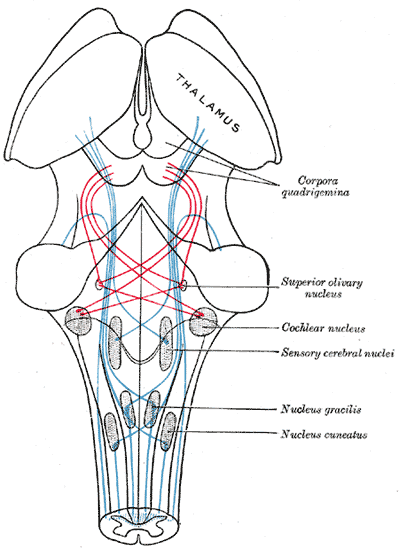
Outputs from both MSOs and both LSOs (plus several other brainstem nuclei) converge in the inferior colliculus (IC) of the midbrain. The IC is a large, conspicuous structure on the dorsal aspect of the midbrain; it is the obligatory waystation for essentially all ascending auditory information. Lesions here cause severe deafness; surgical implantation here is being investigated for patients in whom cochlear implants are insufficient.
The IC is where the various auditory-brainstem codes — left vs right ITD, left vs right ILD, plus a host of more specialized signals — are combined into a unified representation of where a sound is. Single IC neurons typically have spatial receptive fields: they fire preferentially for sounds at particular locations in azimuth and elevation. Some IC neurons code azimuth via ITD-derived signals; others via ILD; others via a combination.
By the time information leaves the IC, the brain has a robust spatial map of the auditory scene. This map is what the cortex uses (along with non-spatial information) to construct the conscious experience of where each sound source is.